They walked in with a structure. Here's what happened next.
Named, unedited words from doctors after their interviews. We share readiness gains, never guaranteed outcomes: panels and competition sit outside anyone's control.
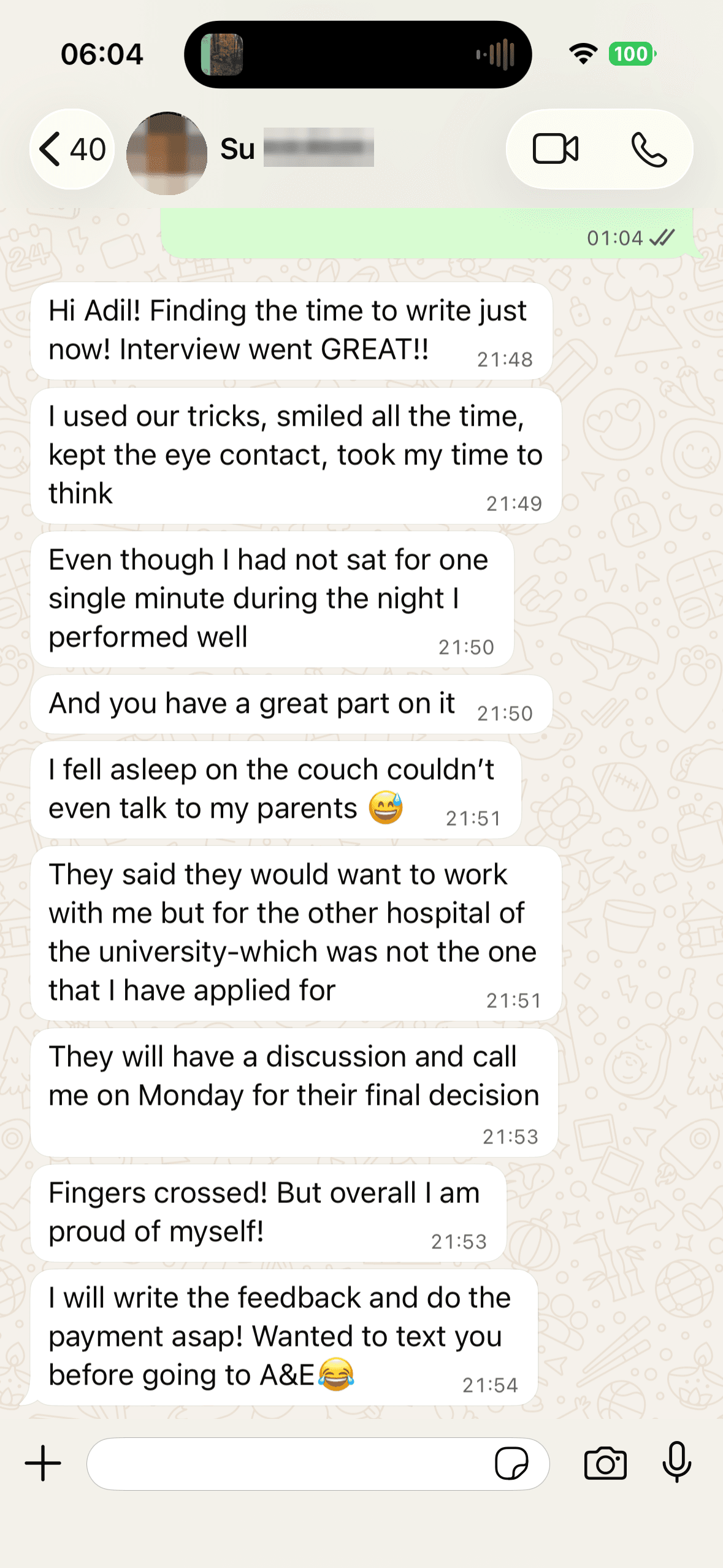
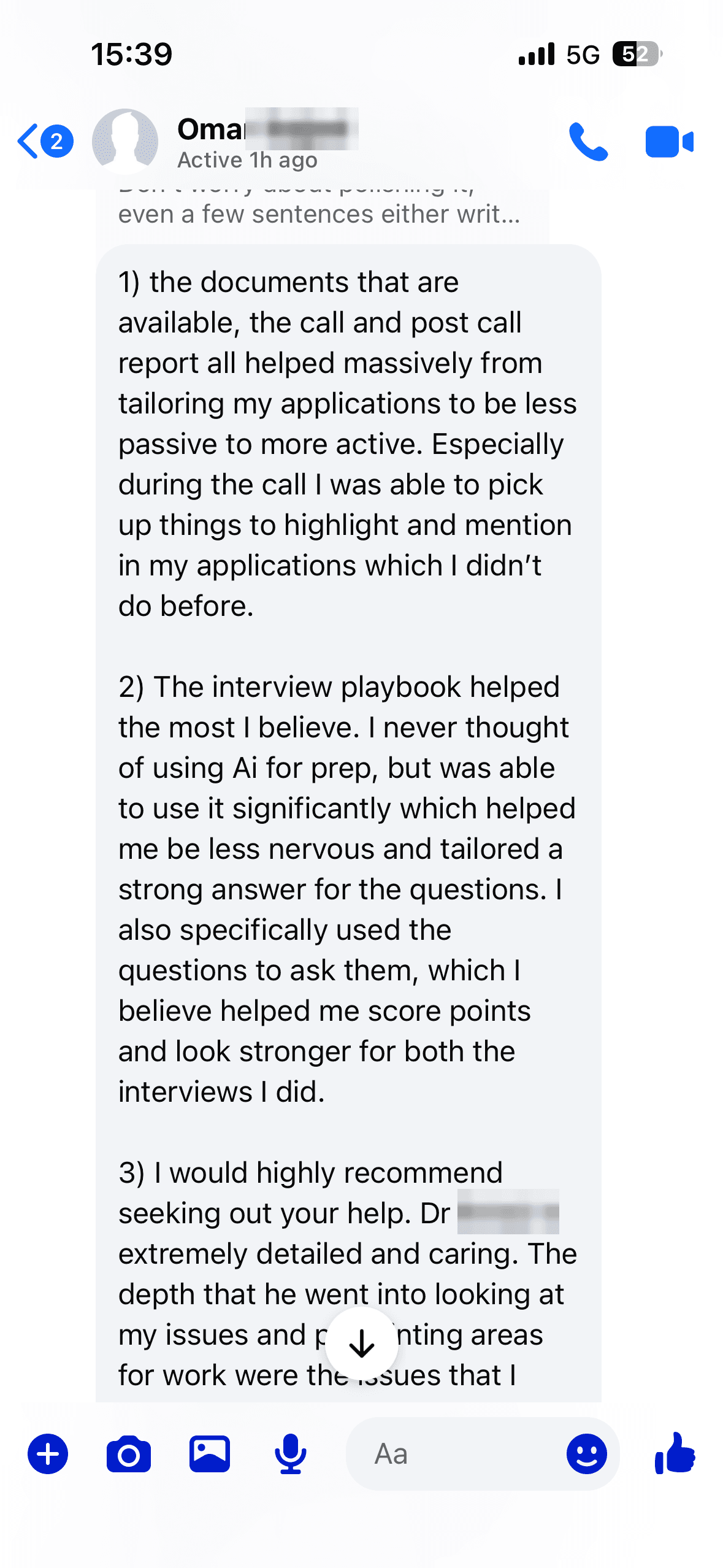
Do you have an NHS interview coming up?
Four thoughts. If any of them sound like yours, you're exactly who this is built for. If not, this probably isn't the right thing for you, and that's fine.
"My interview is booked, and it's close."
Sometimes only days away. You're not browsing careers content; this is the last stretch before it counts.
"There's a lot riding on this one."
A visa. Where your family lives. Getting out of a post that isn't working. The result changes real things, not just a line on your CV.
"I know my medicine. I'm just not sure it shows."
Your clinical knowledge isn't the problem. What you can't tell is whether it comes across clearly, in the right order, under pressure.
"Practising with friends isn't cutting it."
Comfortable practice and cheerful reassurance won't move a score. You want someone who'll tell you precisely where you're losing marks.
A named system, not a pep talk.
Every answer type has a structure panels reward. We teach three, drill them until they're automatic, and write down exactly where your marks are going. Your mocks are tuned to your post, too: a teaching fellow panel probes differently to a clinical fellow one.
For clinical scenarios
The structure that turns a rushed clinical answer into a safe, ordered walk-through a panel can score: recognise, assess, act, escalate, communicate.
For ethical & professional scenarios
A repeatable frame for probity, capacity, consent and conflict questions, so you sound considered and balanced rather than caught off guard.
The signalling layer panels reward most
Explicit safety and escalation cues threaded through every answer: the single behaviour that most reliably moves a borderline score upward.
The scenario trainer
A private practice tool with tracked drills between sessions, so the structures stay sharp in the days that matter most. Included with the Interview Intensive as it rolls out.
Your interview date is the deadline.
Pick the depth of preparation that fits how close you are. Founding pricing while the first 10 client places fill: 5 are already taken. Once they're gone, prices return to £449 and £150.
Single Mock Interview
One 75–90 minute realistic mock under genuine pressure, with no hints and no hand-holding, followed by specific structured feedback on exactly where marks are being lost.
Fewer than 3 days out?
Ask about an Emergency Session: the same realistic mock and feedback, extras stripped, arranged fast. It can't be part of the guarantee at that notice, but it still beats walking in cold.
Email your interview date →We work until you walk in genuinely interview-ready.
If you need more than three sessions to get there, they're free, right up to your interview date. This guarantees your readiness, never the job. Panels and competition sit outside anyone's control, so we'll never promise an offer.

He sat these exact interviews. Then he worked out why the improvement happened.
Dr Adil is an NHS doctor, a Core Psychiatry Trainee, who went through these interviews himself. He took his own FY2 standalone score from 55% to 82%, and won three offers from five interviews.
He knows precisely what changed between those two scores. That method (the structures, the signalling, the written feedback) is exactly what he now teaches, one candidate at a time.
The questions doctors actually ask.
Is this for IMGs or UK graduates?+
Both. The panel scores structure, prioritisation and safe signalling regardless of where you trained, and those are learnable. Whether you are a UK graduate or an international graduate, the work is the same: making your reasoning land clearly under pressure.
Which interviews does this cover?+
The core focus is FY2 standalone, trust-grade SHO, clinical and teaching fellow, and CT1-level NHS interviews: the posts I have sat and coached most. I do not routinely prepare candidates for registrar or consultant interviews: those panels expect a depth of specialty seniority that deserves a coach who has been through them.
What if my interview is this week?+
Then book the earliest sessions you can. If you are fewer than five days out the Readiness Guarantee can no longer apply, but the preparation still matters. Ask about an Emergency Session: the same realistic mock and structured feedback, arranged fast, with the extras stripped back.
Why not just practise with friends or with AI?+
Friendly practice is comfortable, and comfort hides the problem. A friend will not score you the way a panel does, will not sit in silence while you ramble, and will not tell you your leadership example is really a working-under-pressure example. AI has its place: timed drills between sessions are exactly what the scenario trainer is for. But it cannot recreate the pressure of answering a senior clinician in real time, or hand you a scored written diagnosis of where your marks are going. A realistic mock exposes what needs fixing while there is still time to fix it.
What exactly does the guarantee cover?+
Readiness, not the job. If you need more than three sessions to walk in genuinely interview-ready, they are free, provided you attend every session, complete the drills between them, and book at least five days before your interview. We will never promise an offer: panels and competition sit outside anyone's control.
What actually happens in a session?+
The first is a cold diagnostic mock under genuine pressure, scored as a panel would. You get the feedback twice: talked through at the end of the call, then as a written debrief mapping where marks were lost. The next sessions drill the specific answer types you are weakest on using SIGNAL, PACES and SAFE, finishing with a full mock, plus a short, informal debrief call after your real interview.